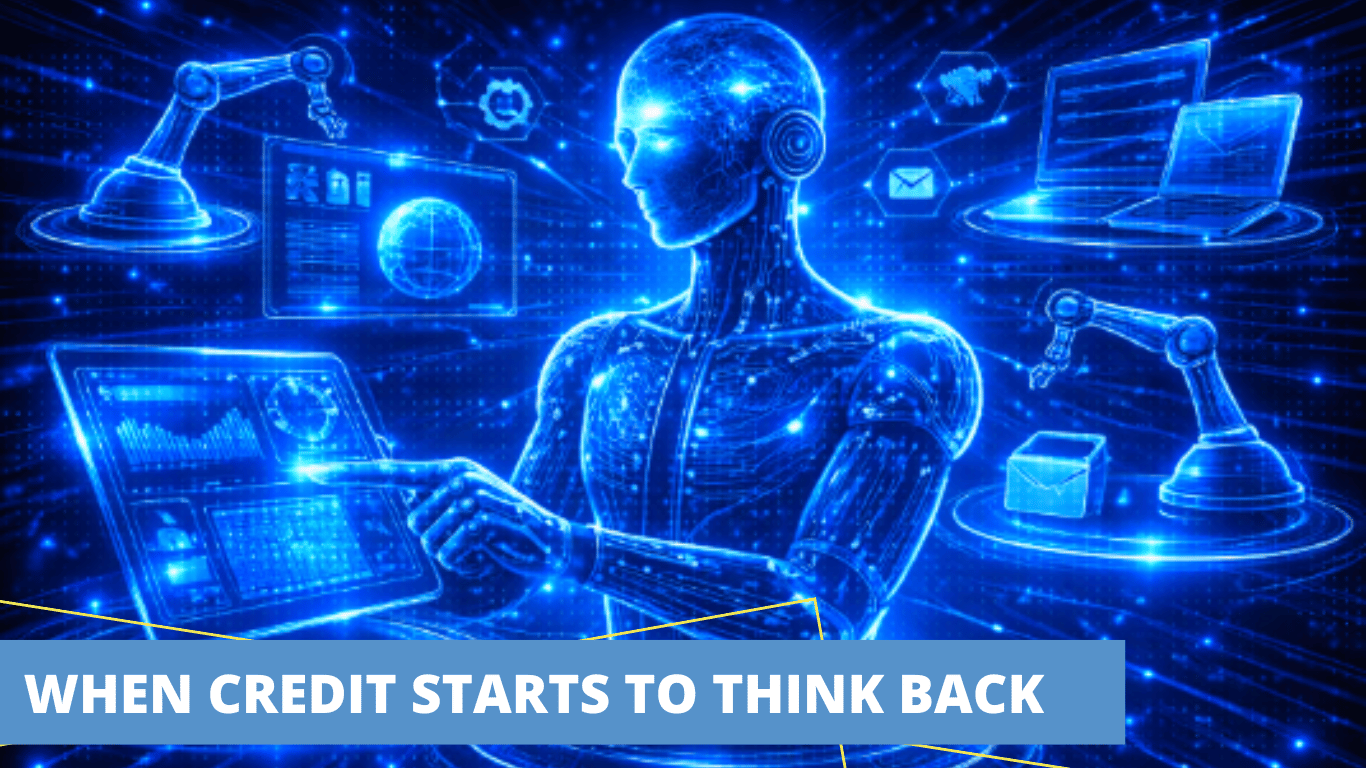
Agentic AI is pushing lending beyond automation and into a new phase of decision architecture.January 13, 2026The FocusFor most of modern banking history, credit has followed a familiar logic. Gather data, apply models, score the outcome, and pass the decision along a defined chain of review. Technology made that process faster, but rarely more reflective. Automation reduced cost and time, not ambiguity. That balance is starting to change. What agentic AI introduces into credit evaluation is not simply speed or scale, but agency inside the process itself. Decisions are no longer treated as static outputs of a single model. They are becoming sequences of judgments, checks, escalations, and revisions that unfold dynamically, often before a human underwriter ever intervenes. This matters because credit has always been a high-stakes domain where efficiency and accountability sit in tension. Too much automation raises concerns about opacity and bias. Too much human review slows markets and excludes marginal borrowers. Agentic systems are being positioned as a way to absorb that tension rather than resolve it outright. The shift is visible in how data is treated. Instead of acting as a fixed input, data is increasingly interrogated, enriched, challenged, and contextualised in real time. Unstructured information, edge cases, and inconsistencies are no longer exceptions handled downstream. They are now part of the decision fabric itself. Credit evaluation becomes less about a single score and more about a continuously updated confidence threshold. Equally important is what happens when certainty breaks down. Traditional systems tend to fail quietly, pushing ambiguity into manual queues. Agentic architectures do the opposite. They surface uncertainty early, route it intentionally, and preserve an audit trail of how and why escalation occurred. That changes the governance conversation. Explainability is no longer an afterthought applied to a finished decision; it is embedded into the workflow. This reframes the role of human judgment as well. Underwriters are not removed from the loop, but repositioned within it. Their intervention becomes targeted, contextual, and time-sensitive rather than procedural. The system does not replace expertise; it curates when expertise is needed most. What we are watching is credit moving from rule execution to decision choreography. The lending stack is beginning to resemble a coordinated environment where models, agents, and humans interact continuously, rather than a linear pipeline that hands off responsibility at fixed stages. That evolution carries implications beyond credit. It signals how regulated decision-making may adapt more broadly as agentic AI matures. Trust will not be built by claiming neutrality or intelligence, but by showing how systems reason, hesitate, escalate, and learn over time. The question for institutions is no longer whether AI can approve loans faster. It’s whether they are prepared to design systems that can justify decisions while operating at machine speed. Continue readingAgentic AI enabled credit evaluation process: A Strategic Blueprint, written for FinTech Weekly by Bhushan Joshi, Dr Manas Panda, and Raja Basu, examines how generative and agentic AI are being combined to redesign credit evaluation workflows, governance models, and human-in-the-loop architectures. Your Voice MattersShare your insights with us! 🚀 Join over 6,000 fintech professionals staying ahead of the curve. Follow FinTech Weekly for expert insights & industry updates! |

|
|
Tipping Point UG (haftungsbeschränkt) An der Bottmühle 5, 50678, Köln This email was sent to {{ contact.EMAIL }} You've received this email because you've subscribed to our newsletter. |