Christoph Fleischmann is a serial founder focused on emerging technologies and the future of work. He is the Founder and CEO of Arthur Technologies, where he works on AI-enabled collaboration models that bring together artificial intelligence and immersive technologies to reimagine how teams align, decide, and collaborate.
Discover top fintech news and events!
Subscribe to FinTech Weekly's newsletter
Read by executives at JP Morgan, Coinbase, Blackrock, Klarna and more
Artificial intelligence’s use in the workplace is booming. Exploding Topics reports that an overwhelming majority, 77%, are either using AI or exploring its use.
In the fintech sector, according to NVIDIA, that number hits 91%.
Still, AI’s use is only scratching the surface of its potential impact on the workforce.
Most conversations around AI in the workplace focus on the technology as a productivity tool. So, we'll talk about how automation helps draft emails faster, summarizes documents, answers questions through chatbots, or accelerates individual tasks.
Do these developments matter? Absolutely. They save time, reduce friction, and help individuals move faster.
But how fast we accomplish tasks does not fundamentally change how we work.
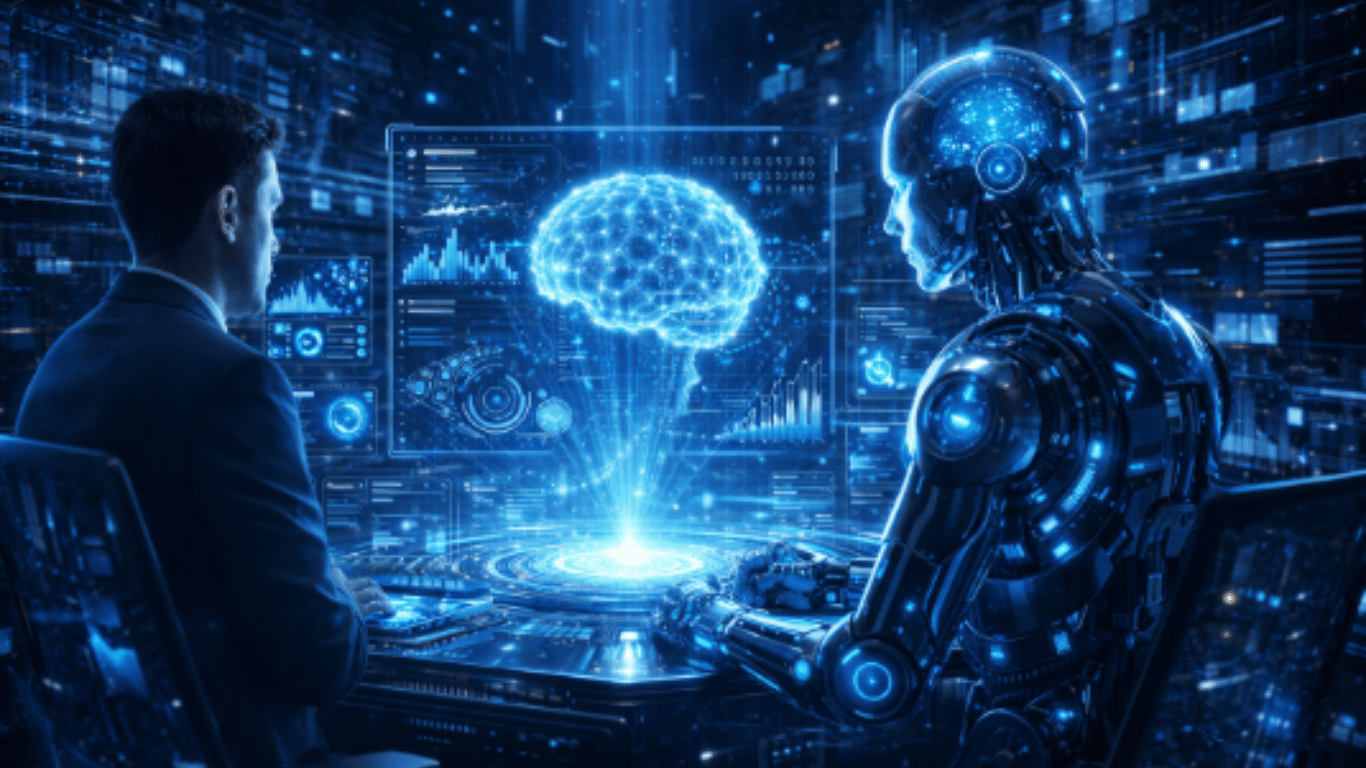
Placing AI at the heart of the collaboration and workflow offers an opportunity for a bigger workplace transformation. We can evolve AI from a tool that people use occasionally to a digital co-worker that participates continuously in how teams align, decide, and execute.
From Individual Assistance to Collective Intelligence
Most AI tools today are built for one-to-one interaction. You ask a question, the system responds. While useful, this model reinforces a fragmented way of working: each person optimizes their own output, without full awareness of the broader context.
Yet, the most complex and valuable work does not happen in isolation. It happens in meetings, workshops, and cross-functional teams. It’s why we brainstorm and look to “bounce” ideas off one another. But collaboration can also be hard, involving negotiation, prioritization, trade-offs, and shared understanding.
AI can override these challenges. But only if we stop treating it as a personal assistant and start treating it as a participant in collaboration.
The Digital Co-Worker Concept
A digital co-worker is more than just an interface or a chatbot you consult from time to time. It’s an ongoing presence embedded in workflows that understands goals, context, and people. It doesn’t replace human judgment, creativity, or leadership. Instead, it’s a member of your team that reduces the cognitive load that teams struggle to manage at scale.
This requires a shift in mindset.
Instead of asking, “What task can AI do for me?” the better question becomes: “How can AI help us work better together?”
One approach is giving AI a clear and recognizable presence within collaboration spaces. Not to humanize AI for novelty’s sake, but to make its role predictable and trustworthy. When AI is visible and consistent, teams can interact with it more naturally, like they would with a colleague who facilitates rather than dominates.
Rethinking Alignment and Workshops
Alignment meetings and large workshops are essential. They are often famously inefficient.
In traditional formats, opinions surface slowly and unevenly. Some participants are more vocal than others, while others hesitate to share dissenting views in front of a group. To hear every perspective, facilitators often resort to going around the room, consuming valuable time before the real discussion even begins.
AI offers a fundamentally different approach.
A digital co-worker can effectively multiply itself, engaging each participant individually, in parallel. This gives people the space to share thoughts candidly, without social pressure, and at their own pace. The AI can then synthesize this input instantly, with perfect recall.
Instead of starting a session by collecting opinions, teams can begin with clarity: where there is agreement, where perspectives diverge, and which topics truly deserve focus. In brainstorming settings, AI can cluster ideas, surface shared themes, highlight outliers, and even introduce prompts that push thinking forward.
The goal isn’t to reduce discussion, but to make it more meaningful.
Executing Work, Not Just Responding
Where digital co-workers begin to really change how work gets done is execution.
Most AI systems today wait for prompts. Digital co-workers act within workflows. They don’t just generate text; they create shared artifacts that teams can work with together.
In collaborative environments, this could mean automatically creating pinboards in a virtual room to organize ideas, visualizing a discussion as a live graph, or mapping dependencies as decisions evolve. Notes are captured, but so is structure. Insights are made visible.
By handling documentation, visualization, coordination, and follow-through, AI removes much of the operational drag that slows teams down. This frees people to focus on what only humans can do well: delegating, making decisions, navigating ambiguity, and exercising judgment.
This isn’t automation for its own sake. It’s enabling better leadership and more intentional collaboration.
Structuring Collaboration in Real Time
Work today is dynamic. Priorities shift, markets move, and teams reorganize. Static processes struggle to keep up.
Digital co-workers can help by continuously structuring collaboration as it unfolds. By analyzing conversations, workflows, and outcomes in real time, AI can surface patterns that humans miss: recurring bottlenecks, unclear decision paths, overloaded teams, or misaligned goals.
This allows teams to course-correct while work is still in motion, rather than relying solely on retrospectives weeks later. Over time, collaboration itself improves, not just individual performance.
Trust, Agency, and Human Leadership
Embedding AI deeply into collaboration raises important questions about trust and agency.
Digital co-workers must support human intent, not override it. Transparency matters. Teams need to understand why AI suggests something, not just what it suggests. Control must remain firmly with people.
When designed well, AI becomes a stabilizing force rather than a disruptive one, augmenting human judgment instead of replacing it.
Looking Ahead
The future of work won’t be defined by how many tasks AI can automate, but by how well it helps humans work together.
AI is only scratching the surface today because we are still thinking too small: optimizing individuals instead of organizations, tasks instead of workflows, speed instead of clarity.
When AI becomes a true digital co-worker, when it executes work, structures collaboration, and learns alongside teams , it unlocks a more sustainable, humane, and effective way of working.
That’s where the real opportunity lies.