
FinTech moves fast. News is everywhere, clarity isn’t.
FinTech Weekly delivers the key stories and events in one place.
Click Here to Subscribe to FinTech Weekly's Newsletter
Read by executives at JP Morgan, Coinbase, BlackRock, Klarna and more.
On March 9, Coinbase CEO Brian Armstrong posted on X that very soon there will be more AI agents than humans making transactions, and that those transactions will run on crypto. The argument was specific: AI agents cannot open bank accounts because they cannot satisfy Know Your Customer requirements. Crypto wallets, generated from private keys without identity verification, have no such barrier.
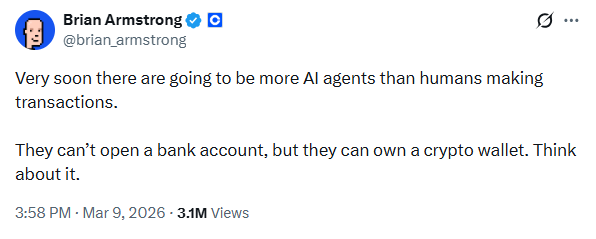
Armstrong described agents being blocked by services that require payment credentials tied to a verified human account. Without the ability to pay autonomously, agents cannot complete the tasks they are deployed to perform. The solution he pointed to was already live.
Coinbase's Agentic Wallets
Coinbase launched Agentic Wallets on February 11, 2026, on its x402 protocol, a payments standard built for machine-to-machine transactions. The protocol had processed more than 50 million transactions at the time of his post.
Wallets can be created and funded in minutes through Coinbase's developer tools, and support gasless trading on Base, Coinbase's layer-2 network built on Ethereum.
Armstrong's Position on the CLARITY Act
Armstrong's post on AI agents arrived less than two months after a separate and significant decision he made about US crypto regulation. On January 14, 2026, hours before the Senate Banking Committee was scheduled to begin its markup session on the Digital Asset Market Clarity Act, Armstrong posted on X that Coinbase could not support the bill as written. The Senate Banking Committee subsequently postponed its markup session.
The CLARITY Act, which passed the House in July 2025 with a 294-134 vote, was designed to establish a federal framework for digital asset markets, dividing oversight between the Securities and Exchange Commission and the Commodity Futures Trading Commission. The Senate Banking Committee's draft introduced provisions that differed substantially from the House-passed version.
Armstrong outlined four objections: restrictions on tokenised equities, DeFi provisions he described as giving the government broad access to user financial records, erosion of the CFTC's authority in favour of the SEC, and the elimination of stablecoin rewards.
Armstrong's March 9 post on AI agents made no reference to the CLARITY Act or to stablecoin regulation. It described a technical problem, the inability of software to satisfy identity verification requirements, and pointed to a technical solution, crypto wallets, already deployed by his own company.
Editor's note: We are committed to accuracy. If you spot an error, a missing detail, or have additional information about any of the companies or filings mentioned in this article, please email us at [email protected]. We will review and update promptly.