
FinTech moves fast. News is everywhere, clarity isn’t.
FinTech Weekly delivers the key stories and events in one place.
Click Here to Subscribe to FinTech Weekly's Newsletter
Read by executives at JP Morgan, Coinbase, BlackRock, Klarna and more.
The dispute that stalled the CLARITY Act since January has a resolution. Politico first reported on Friday that Republican Senator Thom Tillis and Democratic Senator Angela Alsobrooks had reached an agreement in principle on stablecoin yield — the question of whether and how crypto platforms can reward users for holding dollar-pegged tokens.
Alsobrooks confirmed the deal to Politico directly, describing it as the product of months of work and framing it as a way to protect innovation while preventing the deposit flight that banks had argued yield-bearing stablecoins would cause. Tillis described the negotiations as being in a good place while noting he still intends to review the final text with industry stakeholders before the agreement is formalised.
The substance of the deal is consistent with what had been signalled across weeks of negotiations. Rewards on passive stablecoin balances — paid simply for holding a token without any associated activity — will be prohibited. Activity-based rewards tied to payments, transfers, and platform use remain permitted.
Alsobrooks' communications director confirmed to The Block that the senators plan to share the legislative text with industry stakeholders before anything is finalised. No text had circulated as of Friday.
White House Crypto Council Executive Director Patrick Witt, who has been central to the negotiations, called the development a major milestone on X while acknowledging that further work remains on other unresolved issues.
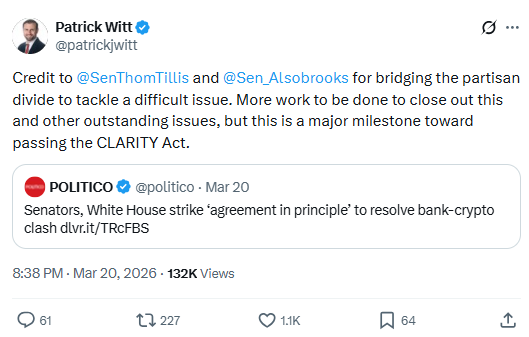
The stablecoin yield question had been the single largest obstacle blocking the Banking Committee markup since the session was cancelled in January.
As FinTech Weekly reported on Thursday, the negotiations had simultaneously introduced a new complication — Senate Republicans were discussing attaching community bank deregulatory provisions to the bill as part of a broader legislative trade involving housing legislation. Friday's yield agreement does not resolve that political question.
The yield deal also does not close out the remaining substantive issues in the bill. DeFi provisions remain contested, with several Senate Democrats citing illicit finance concerns. Ethics language — specifically whether senior government officials should be barred from personally profiting from crypto assets — has not been agreed. Both Alsobrooks' office and the White House acknowledged publicly that ethics and illicit finance provisions still require resolution before the bill can secure a broad bipartisan vote in the Banking Committee.
What Friday's agreement does is clear the path to step one of five that the CLARITY Act must complete before reaching the President's desk. Those five steps, in sequence, are: a Senate Banking Committee markup and vote; a full Senate floor vote requiring 60 votes and therefore meaningful Democratic support; reconciliation of the Banking Committee version with the Agriculture Committee version, which passed in January along party lines; reconciliation of the combined Senate bill with the House-passed version from July 2025; and presidential signature. Friday's deal advances the conditions for step one. Steps two through five are unchanged.
Senator Cynthia Lummis confirmed this week that the Banking Committee markup is targeted for the second half of April, after Easter recess ends on April 13. Senator Bernie Moreno has been direct about what comes after: if the bill does not reach the full Senate floor by May, digital asset legislation may not move again before the midterm election cycle renders major legislation politically untouchable.
As FinTech Weekly mapped against the official 2026 Senate calendar, a late April Banking Committee markup leaves the remaining four steps with a window measured in weeks, not months. The yield agreement changes the content picture. It does not change the clock.
Editor's note: We are committed to accuracy. If you spot an error, a missing detail, or have additional information about any of the companies or filings mentioned in this article, please email us at [email protected]. We will review and update promptly.