FinTech moves fast. News is everywhere, clarity isn’t.
FinTech Weekly delivers the key stories and events in one place.
Click Here to Subscribe to FinTech Weekly's Newsletter
Read by executives at JP Morgan, Coinbase, BlackRock, Klarna and more.
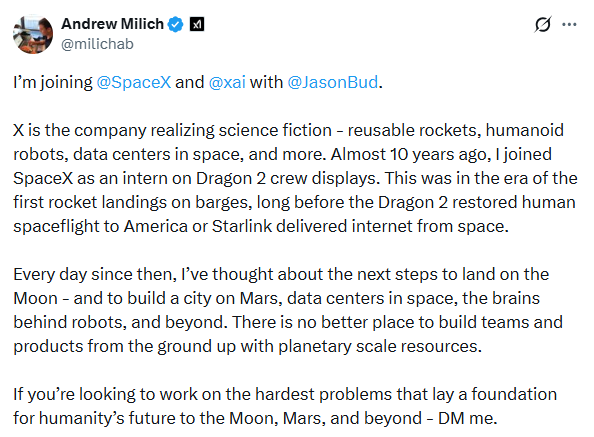
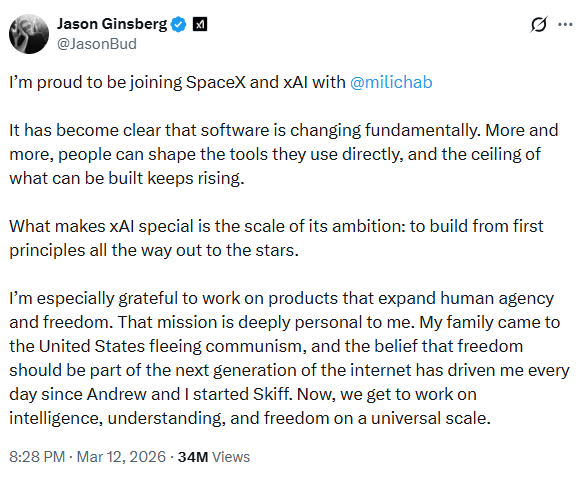
On March 12, Andrew Milich and Jason Ginsberg announced they are leaving Cursor to join xAI and SpaceX, where both will report directly to Elon Musk. The Information first reported the move, citing a person with direct knowledge. Musk reposted both announcements on X.
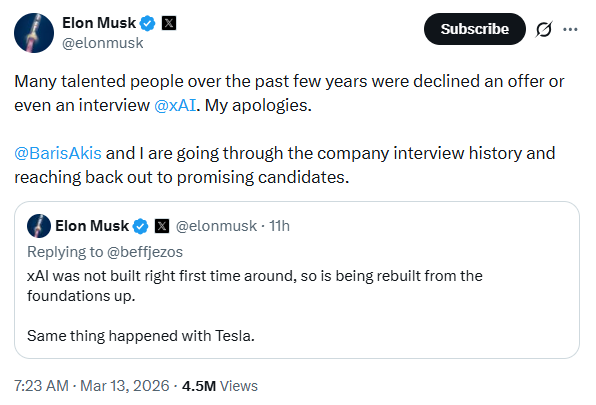
The timing is not incidental. In a post Musk wrote that xAI was not built right the first time and is being rebuilt from the foundations up. He is now bringing in the two people most responsible for the product that defined what good AI coding infrastructure looks like.
Who Milich and Ginsberg are
Andrew Milich and Jason Ginsberg joined Cursor together in June 2025. At Cursor, both held the title of Head of Engineering, Product, sharing responsibility for the company's full product engineering operation.
Milich came to Cursor from Notion, where he had led Notion Mail after Notion acquired Skiff, the privacy-focused document collaboration tool he co-founded. Skiff grew to 2.5 million users before the acquisition. He holds a Stanford CS degree with a concentration in Theory and AI and is an active Sequoia Scout. Before Cursor and Notion, his technical work spanned embedded systems, secure communication infrastructure, and scalable cloud engineering.
Ginsberg's path ran parallel. He co-founded Skiff alongside Milich, serving as CTO, and followed him through the Notion acquisition. Before Skiff, he had worked at Apple and Sequoia Capital, and holds a Stanford MS in Computer Science. At Cursor, he became the public face of the company's engineering philosophy: ship fast, build bottom-up, let engineers own features from idea to production. He built Cursor's Debug Mode over a Thanksgiving holiday because he wanted it personally. The feature shipped weeks later to millions of developers.
Together at Cursor, the two oversaw the product engineering operation that took the company to a $2 billion annualised revenue run rate. Cursor grew to become the most widely used AI coding tool among professional engineering teams, known for the quality of its codebase understanding and the speed of its release cadence. The company shipped updates every two weeks and operated with roughly 20 engineers at the start of 2025.
What they are walking into
xAI is in the middle of a significant restructuring. Half of the company's original co-founders have left. Layoffs have hit multiple projects, including Macrohard, an automation tool, and parts of Grok Imagine, the video generation product that topped leaderboards earlier this year. Musk has been explicit that the company needs to be rebuilt.
The Milich and Ginsberg hire signals what that rebuild looks like in practice. xAI is recruiting product engineers who have shipped AI tools used daily by hundreds of thousands of professional developers, at a company known for moving faster than any of its peers. That is a deliberate choice about what kind of organisation xAI wants to become.
Musk has said previously that AI will bypass coding entirely by the end of 2026. That prediction is the context for the hire, not the contradiction of it. Building the infrastructure that gets AI to that point requires exactly the kind of applied product engineering that Cursor has been doing.
The broader context
The hire arrives two days after Musk posted a pointed warning on X following reports that Amazon had convened a mandatory internal meeting to address a pattern of outages linked to AI-assisted coding changes. Musk's response was two words: proceed with caution.
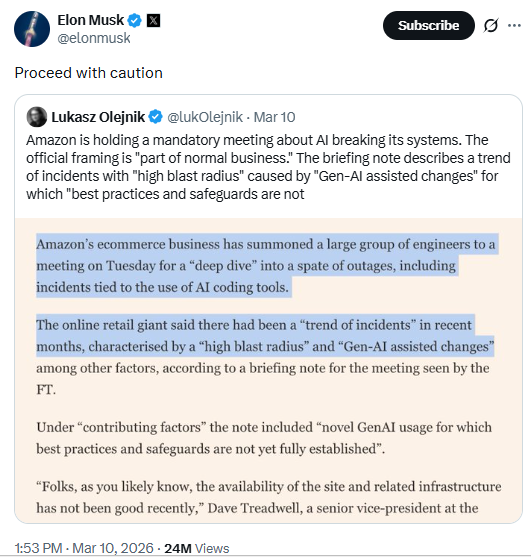
The irony of that context is hard to miss. Musk urged caution about AI coding tools on Monday and announced he had hired two of the most experienced AI coding product engineers in the industry on Thursday. The caution and the hire are not contradictory. They are the same argument: AI coding infrastructure built without the right people and the right process produces outages. Milich and Ginsberg are the people Musk has decided xAI needs to build it right.
Editor's note: We are committed to accuracy. If you spot an error, a missing detail, or have additional information about any of the companies or individuals mentioned in this article, please email us at [email protected]. We will review and update promptly.