
The intelligence layer for fintech professionals who think for themselves.
Primary source intelligence. Original analysis. Contributed pieces from the people defining the industry.
Trusted by professionals at JP Morgan, Coinbase, BlackRock, Klarna and more.
Join the FinTech Weekly Clarity Circle →
For most of 2026, the CLARITY Act stalled on content. The yield dispute between the banking industry and the crypto sector was genuinely unresolved. Two markup sessions were cancelled because the substantive gap was too wide to close in committee. That changed in the six days before the Senate returned from recess. The obstacle is now procedural. The markup date is still missing.
What changed between April 8 and April 10
On April 8, the White House Council of Economic Advisers published a 21-page analysis finding that a full ban on stablecoin yield would increase bank lending by $2.1 billion — a 0.02% improvement — at a net consumer cost of $800 million. The banking industry's core argument, that unrestricted stablecoin yield posed a structural threat to deposit levels and community bank lending, rested on figures orders of magnitude larger. The White House put its own numbers against those figures directly.
The following day, Treasury Secretary Bessent published an op-ed in the Wall Street Journal titled "Digital Asset Rules Need Clarity," calling on the Senate Banking Committee to hold a markup and send the bill to the President's desk. Bessent framed the CLARITY Act as a national security matter, citing the migration of blockchain developers and crypto companies to Singapore and Abu Dhabi as the consequence of sustained US regulatory ambiguity.
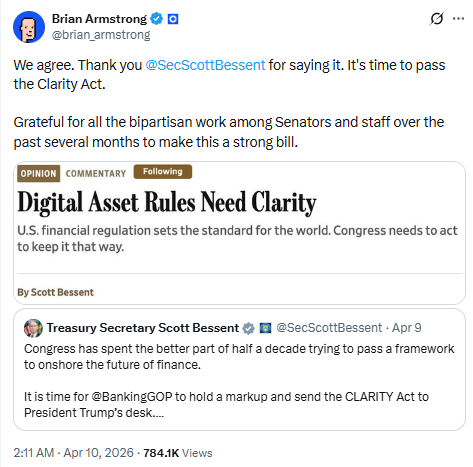
The following day, Coinbase CEO Brian Armstrong posted on X endorsing the bill. Armstrong thanked Bessent and described months of bipartisan Senate work as having produced a strong bill. Coinbase had raised commercial objections to the stablecoin yield provisions at two prior points in the legislative process — objections centered on the bill's treatment of a revenue line that represents a material portion of Coinbase's income. Those objections had shaped negotiations significantly. Armstrong's April 10 post reversed that position.
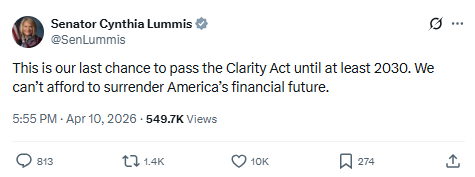
On April 10, Senator Lummis posted on X that this is the last realistic opportunity to pass the CLARITY Act before at least 2030. She added that the country cannot afford to surrender its financial future. The warning carries additional weight: Lummis announced in December 2025 that she will not seek re-election, making her the bill's most prominent Senate champion with no personal electoral stake in the outcome.
What Tim Scott said on Fox Business
On April 14, Chairman Scott appeared on Fox Business's Mornings with Maria and gave the clearest public assessment yet of what remains of the Senate Banking Committee's work. He named three issues. The first is stablecoin yield language, which he believes can be resolved within two weeks. The second is the DeFi provisions, which he also believes can be resolved within two weeks. The third is Republican unity on the committee — ensuring all Republicans are aligned before moving to a vote that may lack Democratic support.
Scott also pushed back on the banking industry's deposit flight argument, noting that savings account balances have increased since the third quarter of last year rather than declining. The Senate Banking chair did not announce a markup date. He did not say April is impossible. He indicated that the timeline depends on resolving the three issues, and that he is optimistic about doing so.
The procedural sequence that actually controls the date
As FinTech Weekly reported when the Senate returned, the markup window is open. But a markup cannot happen without a published text. Under Senate committee procedure, the bill text must be available at least 48 hours before any session begins.
READ MORE: CLARITY Act: Coinbase's Top Lawyer Says a Stablecoin Yield Deal Is Very Close
Senator Tillis, who brokered the Tillis-Alsobrooks stablecoin yield compromise in March, is expected to release the revised yield text this week. Until that text is published, Scott has no document to base a markup date on. The sequence is: Tillis releases text, 48 hours pass, Scott sets a date. Each day the text is delayed is a day the markup cannot be scheduled.
Senator Moreno has stated publicly that the bill must reach the full Senate floor by May to avoid being consumed by the midterm campaign calendar. As FinTech Weekly mapped against the Senate's 2026 working schedule, a late April Banking Committee vote leaves the four remaining steps — Senate floor vote requiring 60 votes, reconciliation with the Agriculture Committee version, reconciliation with the House version, and presidential signature — with a window measured in weeks. Justin Slaughter of Paradigm has estimated that floor procedure alone requires two to three weeks, meaning the Banking Committee must clear the bill by mid-May at the latest for a floor vote to be possible before the calendar closes.
The Lummis 2030 warning, the Moreno May deadline, and Scott's Fox Business timeline all point to the same arithmetic. The content dispute that defined the first quarter of 2026 is largely resolved. The Tillis-Alsobrooks yield compromise, the CEA report, Armstrong's reversal, and the coordinated administration push have closed the substantive gap. The PCAST composition signals where the White House sits on the remaining questions. Coinbase's OCC charter application means the company has a federal regulatory path regardless of the bill's outcome — a factor that likely made Armstrong's endorsement easier, not harder.
The obstacle is now whether Tillis releases the text, whether Scott sets the date, and whether both happen before the calendar makes the question moot.
Editor's note: We are committed to accuracy. If you spot an error, a missing detail, or have additional information about any of the companies or filings mentioned in this article, please email us at [email protected]. We will review and update promptly.