FinTech moves fast. News is everywhere, clarity isn’t.
FinTech Weekly delivers the key stories and events in one place.
Click Here to Subscribe to FinTech Weekly's Newsletter
Read by executives at JP Morgan, Coinbase, BlackRock, Klarna and more.
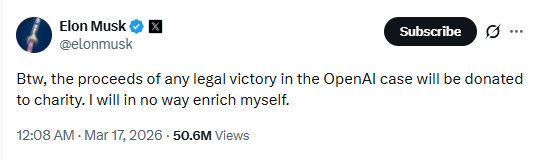
Elon Musk posted on X on March 17 that any proceeds from a legal victory in his lawsuit against OpenAI would be donated to charity and that he would not personally profit from the outcome.
The jury trial is set to begin April 27 in Oakland and is expected to run four weeks. Musk is asking for between $79 billion and $134 billion in damages. The judge overseeing the case made clear she was not impressed by that number.
What the Case Is About
Musk co-founded OpenAI with Sam Altman and others in 2015 as a nonprofit with a stated mission to develop artificial intelligence for the benefit of humanity. He donated $38 million in early funding and departed the board in 2018.
OpenAI completed its recapitalization in October, cementing its structure as a nonprofit with a controlling stake in its for-profit business. As part of that recapitalization, Microsoft holds an investment in OpenAI's for-profit arm valued at around $135 billion.
Musk argues that transition defrauded him. He wants a jury to agree.
Microsoft is also named as a defendant, with Musk alleging the company aided and abetted OpenAI's breach of fiduciary duty. OpenAI has repeatedly described the lawsuit as baseless and part of an ongoing pattern of harassment driven by Musk's competitive interest through xAI, his own AI company.
FintechWeekly has been tracking xAI closely — the company has been on an aggressive hiring run in recent weeks, recruiting senior talent from across the industry.
At a pretrial hearing on March 13, U.S. District Judge Yvonne Gonzalez Rogers openly questioned the reasoning behind Musk's valuation, raising doubts about the method used to calculate alleged harm. She told the court she did not find the damages figure convincing or particularly persuasive.
Despite those reservations, she declined to dismiss the expert witness testimony that supports the claim, acknowledging that striking it at this stage could prematurely end the trial.
The expert is C. Paul Wazzan, a financial economist with Berkeley Research Group. Wazzan determined that Musk is entitled to a substantial portion of OpenAI's current valuation based on his $38 million seed donation when he co-founded the startup in 2015.
His analysis combines Musk's initial financial contributions with the technical and business contributions he made to OpenAI's early team.
Musk's legal team argues his early backing represents between 50% and 75% of the nonprofit's stake in the company.
The charity pledge does not change the legal position. It changes the public one. Musk is seeking the largest damages claim in the history of AI litigation. The judge has already signaled she finds the methodology unpersuasive. A jury will decide starting April 27.
Editor's note: We are committed to accuracy. If you spot an error, a missing detail, or have additional information about any of the companies or filings mentioned in this article, please email us at [email protected]. We will review and update promptly.