
The intelligence layer for fintech professionals who think for themselves.
Primary source intelligence. Original analysis. Contributed pieces from the people defining the industry.
Trusted by professionals at JP Morgan, Coinbase, BlackRock, Klarna and more.
Join the FinTech Weekly Clarity Circle →
The Senate's last working session before its Easter break was March 26. From March 30 through April 9, it is conducting pro forma sessions only — no votes, no business, no senators on the floor. It returns to full session on April 13. The CLARITY Act enters that pause carrying the March 23 stablecoin yield text as its baseline, unrevised.
A revised draft had been expected before the pro forma period began. It was not published. Negotiations continued in the background, and a spokesperson for Senator Tillis confirmed the updated text is expected during recess this week, following additional conversations with industry stakeholders and banks.
The text that currently stands is the one that bans passive yield on stablecoin balances, permits only narrowly defined activity-based rewards, and gives the SEC, CFTC, and Treasury twelve months to define exactly what is permissible. It is the text that banks can live with. It is the text that Coinbase privately told Senate staff they could not accept after reviewing the March 23 draft.
READ MORE: CLARITY Act Update: It Looks Like the Banks Are Still Winning
When negotiations resume in April, the starting position is not neutral. It is the bank-friendly draft. That is how you win a legislative negotiation without formally winning it. You let the clock run.
The PCAST Signal
The composition of the President's Council of Advisors on Science and Technology, announced March 25, maps the White House's actual position more precisely than any public statement. Marc Andreessen and Fred Ehrsam are both PCAST members. Both publicly backed the CLARITY Act in January despite the stablecoin yield restrictions — at the moment when Coinbase's withdrawal threatened to collapse the bill. Both are now inside the most senior presidential technology advisory structure in American government.
Brian Armstrong is not.
As FinTech Weekly reported when PCAST was announced, the January industry fracture produced two sides. One side accepted the yield compromise as the price of a framework that benefits the broader ecosystem. The other side made yield the condition of its support. The people closest to the White House on crypto are the ones who accepted the compromise. The one who did not is outside the structure.
This does not mean the White House has formally abandoned Coinbase's position. It means the advisory infrastructure surrounding the President on crypto issues is populated by the faction that can accept the bank-friendly text. When April's markup negotiations begin, that is the institutional context around the table.
What Coinbase Is Protecting
The commercial logic behind Coinbase's position is in its own SEC filings. The company generated $1,348.8 million in stablecoin revenue in full year 2025 — approximately 19.6% of its $6,883.4 million in net revenue. In the fourth quarter of 2025, stablecoin revenue reached a record $364.1 million, driven by average USDC held in Coinbase products reaching an all-time high of $17.8 billion.
The revenue model depends on distributing a portion of the interest earned on USDC reserves to eligible users as rewards. The March 23 yield text prohibits exactly that structure — directly, indirectly, and through anything economically or functionally equivalent to bank interest. The prohibition is not ambiguous. It is the commercial model.
Coinbase's shareholder communications describe the rewards programme as a primary driver of USDC growth and adoption. Both parts of that statement are accurate. The rewards programme drives USDC uptake. Restricting it restructures a revenue line that contributed more than $1.3 billion to the company's top line last year. Armstrong's position is commercially coherent. It is also, for the second time, the position that leaves the bill stalled when the Senate suspends normal business.
Why XRP Holders Are Angry
The #BoycottCoinbase movement that emerged on X from March 25 came predominantly from the XRP community. The logic is specific and direct.
On March 17, the SEC and CFTC published a joint interpretive release that formally named XRP as a digital commodity — alongside Bitcoin, Ethereum, Solana, and 12 other assets — removing it from securities law coverage. The CLARITY Act's market structure provisions would codify that classification into federal statute, making it permanent and reversible only through an act of Congress. A future SEC chair cannot undo a statute.
XRP holders benefit directly and materially from the CLARITY Act's passage. Coinbase's stablecoin revenue model is what is blocking that passage — for the second time. The boycott is the community's way of attaching a commercial cost to a legislative obstruction that is costing them a regulatory outcome they have spent years fighting for.
The anger drew additional fuel this weekend from the resurfacing of 2023 remarks by Ripple's former Chief Technology Officer David Schwartz. In May 2023, Schwartz said publicly that the story of XRP's listing on Coinbase was one he wished he could tell but could not.
He subsequently described what he explicitly labelled a "completely made-up hypothetical" — an exchange that refused to list a token despite clear commercial incentives, demanded millions to do so, and eventually reached a deal. Schwartz did not confirm the hypothetical reflected real events and did not name Coinbase. Those remarks were recirculated on X this weekend, stripped of the hypothetical framing, and amplified by the existing community frustration over the CLARITY Act. The two issues are not the same. They arrived together because the anger already existed.
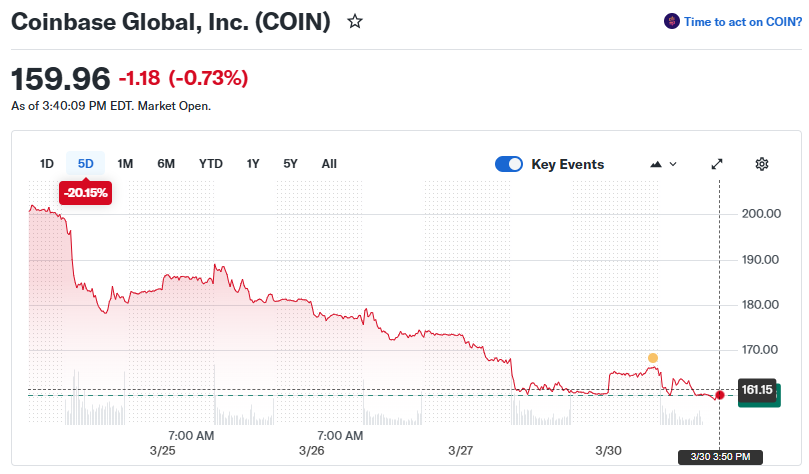
Coinbase's stock closed at its lowest level since February on March 26 and has continued lower. COIN is trading at approximately $161, down roughly 65% from its July 2025 peak of $444.65. The decline reflects broader crypto market pressure and macro conditions — not the boycott itself, which postdates the sharpest moves. But the political cost within the crypto community is real and accumulating.
Source: Yahoo! Finance
What Happens in April
The Senate Banking Committee markup is targeted for the last two weeks of April. Chairman Tim Scott controls the calendar. Before he puts a date on it, the yield text needs to hold, and outstanding issues beyond yield — DeFi provisions, token classification, and tokenization treatment — need to reach resolution. Those are the issues that will occupy negotiators during the recess period before the Senate returns to full session on April 13.
The yield text that goes into that markup will be negotiated against a baseline that is bank-friendly, without a crypto czar managing the process from inside the White House, with a PCAST advisory structure weighted toward the faction that accepts the current framework, and with a Coinbase whose second objection has cost it political capital it spent years building inside Washington.
The banks did not need to win the argument in March. They needed the Senate to go home with their text intact.
That is what happened.
Editor's note: We are committed to accuracy. If you spot an error or have additional information, please email [email protected].